




















Empowering Construction SMEs: Highlights from Our National Seminar in Bucharest
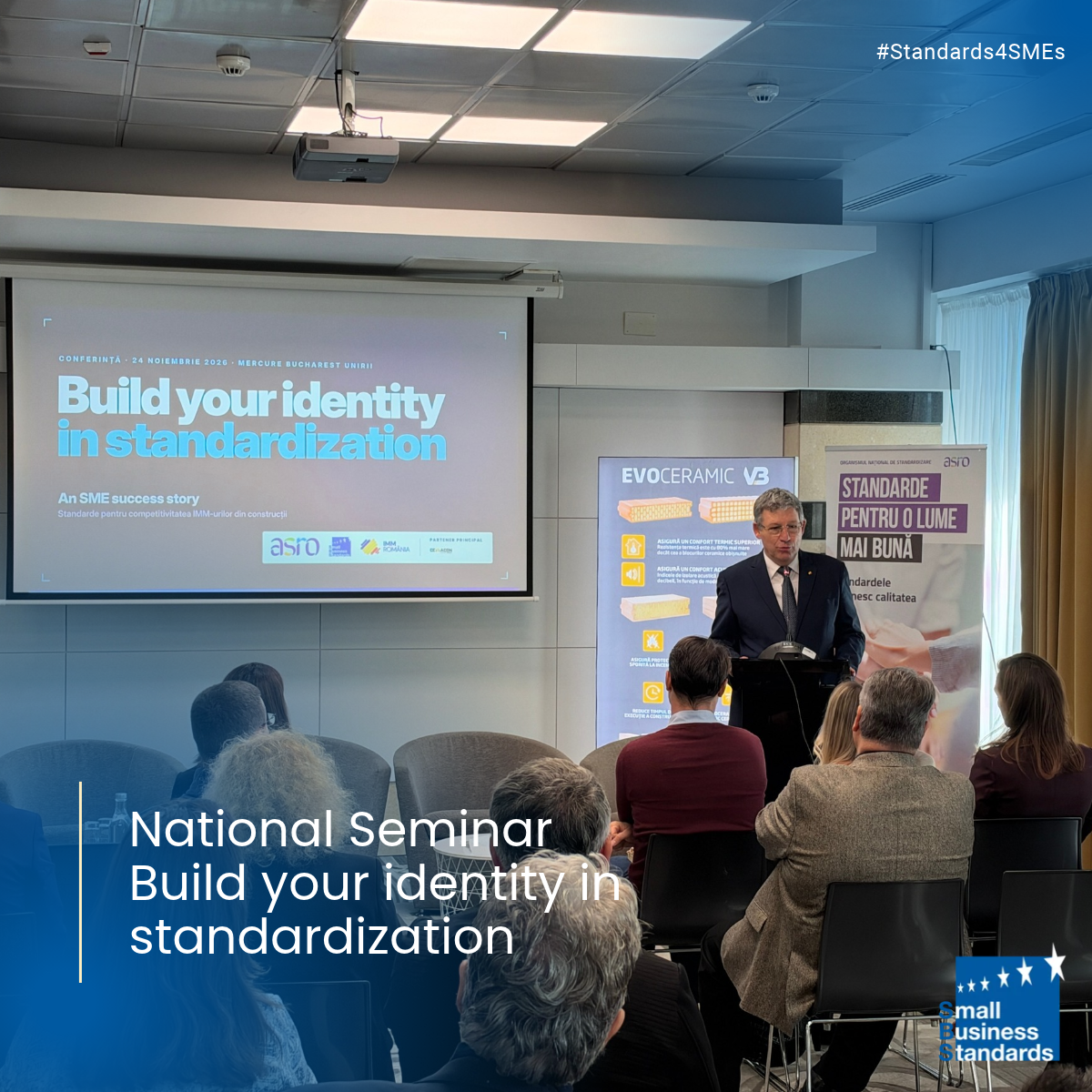
On 24 November 2026, Small Business Standards (SBS) co-organised the national conference “Build your identity in standardization. A SME success story” at Mercure Bucharest Unirii alongside the Romanian Standards Association (ASRO) and IMM România, with CEMACON as main partner. Bringing together entrepreneurs, designers, public authorities, and technical experts, the event delivered a clear message: the technical rules that will govern the construction sector for years to come are being written today, and smaller firms have every reason to help shape them.
At the core of our mission is ensuring that European standards reflect the realities of small businesses. Representing SBS at the event, Technical Officer and Expert Coordinator Evangelia Tsiala highlighted how our network brings SME experts directly into European technical committees. Whenever new rules are drafted, from Eurocodes to construction products, our experts ask one essential question: Can a small company actually apply this? Beyond committee work, SBS supports firms through practical resources like our implementation guide for the revised Construction Products Regulation (CPR), while advocating at the EU level for faster standardisation processes, free access to legally binding standards, and stronger SME inclusion within national standards bodies.
Throughout the conference, speakers emphasised that standardization is the foundation of a trustworthy, competitive construction market. ASRO President Alexandru Stoichițoiu and IMM România First Vice-President Florin Duma underscored how standards create a level playing field for all bidders while helping small firms boost productivity despite rising costs and workforce pressures.
A major focus of the discussions was the rapid digital and regulatory shift facing the sector—particularly Romania’s new Code on spatial planning, urban planning, and construction (CATUC), Building Information Modelling (BIM), and the Digital Product Passport (DPP). Speakers from public authorities, architectural bodies, and industry associations explored how compatible standards—such as the EN ISO 19650 series and upcoming European rules for digital product passports and building logbooks—connect product data directly to project models and building records. The consensus for SMEs preparing for this transition was practical: set clear business objectives, invest in staff training, and lean on professional associations before spending on new software.
As SBS Eurocode 7 expert Alexandra Ene noted during the discussions, limited resources remain the biggest barrier keeping SMEs away from standardisation committees. However, firms that do participate gain a clear strategic advantage—understanding the reasoning behind new requirements years before they become mandatory and acting as trusted guides for their peers.
The event also illustrated how standards translate into everyday business value, from smart building interoperability and cybersecurity under the REGo_ETSI project to rigorous quality control in manufacturing, as demonstrated by CEMACON. Finally, real-world success stories from Romanian architects, structural engineers, galvanisers, and digital clusters showed how active involvement in technical working groups helps smaller companies validate innovative designs, shape national technical rules, and build market credibility.
Ultimately, the Bucharest seminar reinforced that standardisation is not merely a compliance exercise for large corporations, it is a strategic tool for growth.